top of page
Favorites posts

Can You Simplify a Malaysian Chinese Wedding Without Losing the Tradition?

Sep 24
6 min read
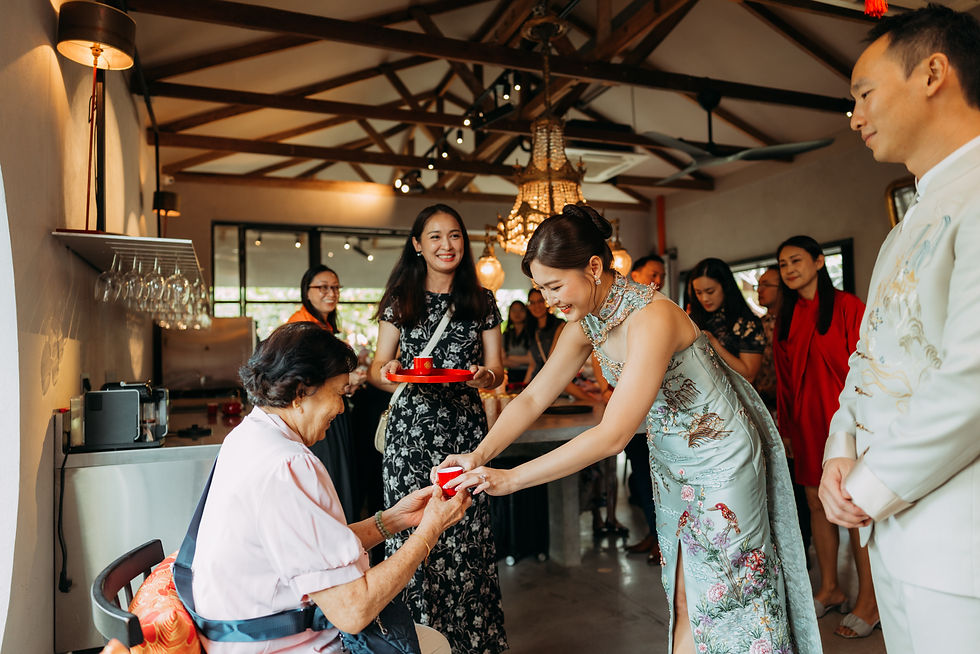
Bride serves tea to an elder during a Chinese wedding ceremony

A traditional Malaysian Chinese wedding can involve a surprisingly long list of rituals, outfit changes, family visits and ceremonial details.

But what if you want something simpler?

Maybe you are planning an intimate wedding with 50–100 guests. Maybe you are getting married at a restaurant, garden venue or private house rather than a traditional banquet hall. Or perhaps one of you is not Chinese and you are trying to understand which parts of the wedding actually matter to the family.

The good news is that a modern Chinese wedding does not have to reproduce every detail of a traditional wedding exactly as it was done generations ago.

The key is knowing what carries meaning, what can be adapted, and what is simply a modern addition.


Start with the rituals that matter

For many Malaysian Chinese families, the Tea Ceremony (敬茶, jìng chá) is one of the most meaningful parts of the wedding.

The couple serves tea to their parents and elders as a gesture of respect, gratitude and acceptance into the family.

This is usually one of the rituals we would recommend protecting when simplifying a wedding.

The guest list, however, does not necessarily need to include every extended relative.

Who should be included depends on the family, dialect group and individual expectations. Some families will want a larger ceremony involving grandparents, uncles, aunts and senior relatives; others prefer something much more intimate with parents and immediate family.


The important question is not simply:

“Who is traditionally supposed to be there?”

It is:

“Who does this ritual actually mean something to in our family?”

That is a conversation worth having with your parents before finalising the wedding timeline.


Couple poses together in traditional Chinese wedding outfits

Gate-crashing can be shortened

The Fetching of the Bride (接新娘, jiē xīn niáng) is another familiar part of a Malaysian Chinese wedding morning.

The groom arrives with his heng tai, meets the ji mui and has to get through the gate before he can see the bride.

Today, the gate-crashing games can become quite elaborate.

But the games themselves are not the core meaning of the wedding ritual. They are a modern social element that has developed around the traditional practice.

So if your priority is a beautiful, relaxed wedding morning, there is no reason for this part to take an hour.

Twenty to thirty minutes can be more than enough.

Keep the ritual. Edit the performance.


What about the red veil?

The bride may traditionally be covered with a red veil before the groom enters.

After the gate-crashing, the groom unveils his bride, traditionally using a ceremonial weighing rod (秤杆, chèng gǎn).

The gesture carries an auspicious meaning and is still meaningful to families who observe this tradition.

But preserving this ritual does not necessarily mean that the bride needs to wear an entirely traditional red bridal outfit.

A modern compromise can be a contemporary white wedding dress paired with a red veil for the ceremony.

This allows the couple to retain a recognisable ceremonial element without adding another complete outfit change.

Of course, this is exactly the kind of detail that should be discussed with the family rather than treated as a universal rule. Chinese wedding customs vary between families and dialect traditions.


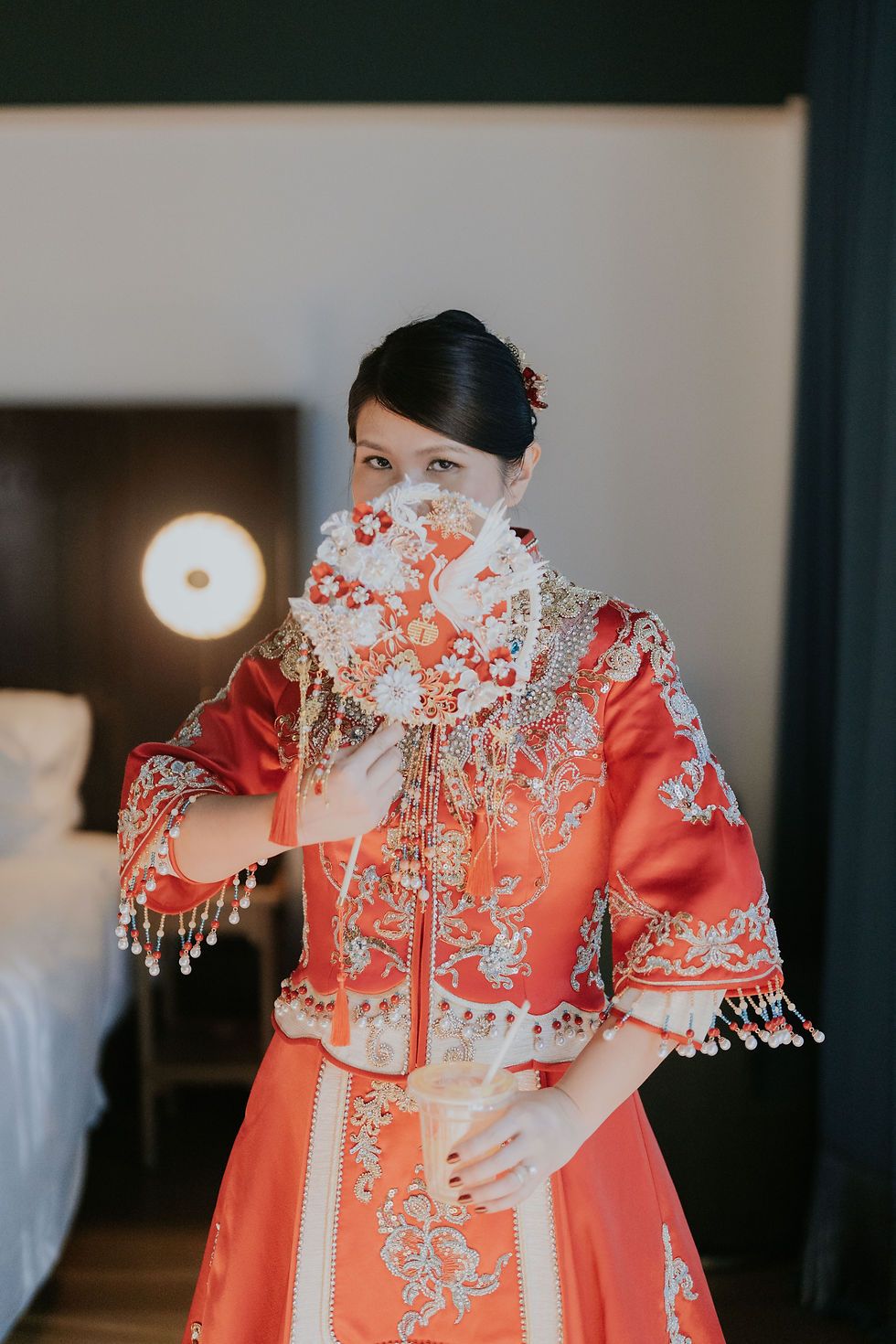
Bride wearing a traditional red Chinese wedding outfit

Do you have to wear a qun kwa?

The qun kwa (裙褂) remains an important traditional bridal outfit for many Chinese couples.

But wearing one is not the only way to honour the tradition.

If you genuinely love the qun kwa, wear it.

If you do not want another outfit change, or your wedding is intentionally small and contemporary, you may decide that the red veil, tea ceremony and other meaningful rituals are enough.

The goal is not to collect as many traditional elements as possible.

It is to understand what each element means — and decide what belongs in your wedding.


What if the wedding is not at home?

This is where modern Malaysian weddings often require a little more creative thinking.

Traditionally, the bride is fetched from her family home and the couple then travels to the groom's family home, where another tea ceremony may take place.

But many contemporary couples are getting married at restaurants, private venues, villas, hotels and other locations where neither family home is practical.

That does not mean the ritual has to disappear.

You can create a symbolic transition within the wedding-day flow, or arrange the tea ceremony at a suitable venue before the main celebration.

For some couples, a short drive or change of location can retain the feeling of transition. For others, it makes more sense to have both families meet at one carefully chosen venue.

Again, the objective is not to recreate every logistical step of a traditional wedding.

It is to preserve the meaning of the transition.


Wedding couple stands beneath a red double happiness decoration

What can you actually simplify?

Quite a lot — depending on your family.

Common elements that couples choose to shorten or adapt include:

  • lengthy gate-crashing games

  • multiple outfit changes

  • travelling between several locations purely for photographs

  • serving tea to an extremely long list of relatives

  • elaborate ceremonial décor that has no personal meaning

  • repeating similar rituals at several locations

  • some of the more elaborate details traditionally carried out at home

But before removing something, ask your parents.

For one family, a particular ritual may feel completely optional.

For another, that same ritual may be deeply emotional and important.

There is no single checklist that can tell every Malaysian Chinese couple what they should keep.


A simpler wedding does not mean a less traditional one

One of the biggest misconceptions about modern Chinese weddings is that simplifying the day automatically means abandoning tradition.

It doesn't.


You can have:

  • a shorter gate-crashing

  • a smaller tea ceremony

  • a modern wedding dress

  • a contemporary venue

  • fewer outfit changes

  • a relaxed timeline

And still have a wedding that feels deeply connected to your family and cultural traditions.

The difference is that every element has been chosen intentionally rather than included simply because “that's how weddings are done.”


If you are planning a Chinese Tea Ceremony outside the family home

A family home is not always the easiest place to host a tea ceremony.

There may not be enough space, parking may be difficult, relatives may be arriving from different locations, or you may simply want the ceremony to take place somewhere more comfortable and aesthetically considered.

For couples who want to keep the tea ceremony intimate without hosting it at home, we offer dedicated Tea Ceremony Packages at selected venues in Kuala Lumpur.

These are designed specifically for smaller family ceremonies and can combine the venue, ceremony coordination, styling and selected vendors into one manageable setup.

They can also be useful when the tea ceremony is a separate part of the wedding day rather than a full wedding celebration.


Couple serves tea to family elders during a Chinese wedding ceremony

Planning a larger wedding with Chinese traditions?

If the tea ceremony is just one part of a larger wedding — alongside a Nikah, Western ceremony, dinner reception, guest accommodation or multiple venues — it usually makes more sense to plan the whole day as one connected experience.

At Midsummer Events, our Wedding Planning & Coordination service covers venue sourcing, budget management, vendor coordination, timeline development and actual-day coordination, with experience in multicultural and destination weddings in Malaysia.

We also provide Wedding Styling & Design for couples who want the cultural elements of the day to sit naturally within a contemporary visual concept rather than feeling like a collection of separate decorations.


Start with the meaning, then build the wedding


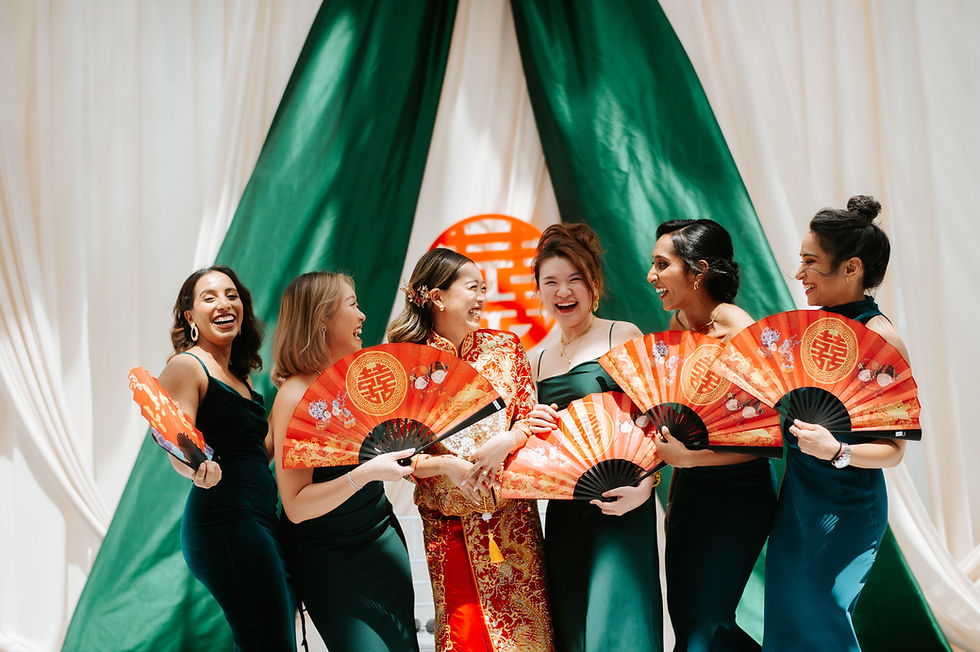
Bride in a traditional red Chinese wedding outfit celebrates with friends holding red fans.

A modern Chinese wedding does not need to be a choice between “traditional” and “modern.”

There is a much more interesting middle ground.

Keep the rituals that carry emotional meaning.

Understand the traditions well enough to know what can be adapted.

And give yourselves permission to remove the things that no longer serve the people getting married.

Because the goal is not to reproduce your grandparents' wedding minute by minute.

It is to carry forward the parts of the tradition that still matter to your family — while making room for the wedding you actually want to have.


Planning a Malaysian Chinese wedding?

Whether you need help with a standalone Tea Ceremony or are planning the entire wedding in Malaysia, we can help you work out what makes sense for your family, venue and celebration.

Explore our Tea Ceremony Packages →

Explore Wedding Planning & Coordination →


Comments


bottom of page